"If we all did the things we are capable of doing, we would literally astound ourselves."
Thomas Edison
Showing posts with label preschool. Show all posts

Saturday, March 16, 2013

Egg-citing Activities for PK - 5th Grade

I am so egg-cited to share these quick, easy, and inexpensive activities with you using... you guessed it... plastic eggs! I saw an idea on Pinterest (thanks Pinterst!) and I just rolled with it :) And what a great time of year to try these ideas, as there is ample supply of plastic eggs in stores right now! Here is what we are using our plastic eggs for:

Letter Matching (Pk & K)
1) You will need 26 plastic eggs with the connector cut off each egg (so you can pull them apart and mix them up) and a gallon size Ziploc bag.
2) Using a permanent marker, write an uppercase letter on the top half of the egg and its corresponding lower case letter on the bottom half of the egg.
3) Disconnect the eggs and mix them up using a Ziploc bag (this will be your storage for the eggs as well).
4) Dump out the eggs and have your child match up the uppercase letters with their corresponding lowercase letters by putting the eggs back together.

Twist on Phonics (K & 1st)
Each egg should be able to
twist freely to each letter,
creating a new phonics word

1) You will need several plastic eggs with the connector cut off each egg (so you can twist them freely while still keeping the egg closed) and a gallon size Ziploc bag.
2) Using a permanent marker, write the ending phonic sound on the top half of the egg. For example, you could make an egg for each of the following sounds: an, at, it, ig, et, en, ox, op, ug, ut.
3) On the bottom half of the egg, write single letters or double letters to spell a word corresponding to your phonic sound. For example, for the "an" sound you could write letters m, p, f, and c. This would give you the words man, pan, fan, and can on this egg.
4) Give you child an egg and let him twist the egg to create new words and have fun while learning phonics. You can do this as a free activity using all the eggs, or you can use specific eggs during specific studies, ie. ig and it eggs on short i day.
5) This can also be a good review for 1st graders to just practice speed reading without having to sound out the letters.


Compound Word Mix-Up (2nd - 5th)


1) You will need several plastic eggs with the connector cut off each egg (so you can pull them apart and mix them up) and a gallon size Ziploc bag.
2) Using a permanent marker, write the first word of the compound word on the top half of the egg. Then write the second word of the compound word on the bottom half of the egg. For example, you might write "pea" on the top and "nut" on the bottom, creating the word "peanut" on the egg.
3) You can make as many or as little eggs as you'd like. The neat thing about this activity is kids are learning new compound words all the way through 12th grade so this is something you can do for several years. I put 2nd-5th grade because I assume older children may not find this as amusing as younger ones. (Note: I will be posting another blog all about compound words for 2nd grade which will include a large word list. Keep an eye out for it!)
4) Disconnect the eggs and mix them up using a Ziploc bag (this will be your storage for the eggs as well).
5) Dump out the eggs and have your child match up first word with its corresponding second word to create compound words and putting the eggs back together.

Other uses for plastic eggs (I am planning to do these but didn't get to it last night):
  • Capitals Game (2nd): Top half of the egg has the state capital (Lincoln), bottom half has the state (Nebraska).
  • Multiplication Mix-up (2nd-5th): Top half of the egg has the problem (3x5), bottom half of the egg has the solution (15).
  • Addition/Subtraction Matching (K-2nd): Top half of the egg has the problem (10-8), bottom half of the egg has the solution (2).
  • Twist on Blends (1st & 2nd): Bottom half of the egg has the blend (TH), top half of the egg has several endings (ink, at, is).
  • Twist on Long Vowel Practice (1st & 2nd): Top half of the egg has a long vowel ending (ike), bottom half of the egg has several beginning letters (b, h, str, l).
  • Twist on Rhyming (PK-1st): Top half of the egg has an ending sound (ook), bottom half of the egg has several beginning letters (b, l, h, sh).
And don't forget you can use any of these egg ideas to have egg hunts as an added bonus to your lessons!

There's just so many neat ways to use plastic eggs in your classroom and the great news is they are cheap!! I bought 100 eggs for about $5 at Wal-Mart. I'm planning to go back after Easter and stock up on some more (they do break easily but are also easy to replace)!

Have fun with it!
Bye for now,
Kristina 


Wednesday, February 6, 2013

Au Naturel

"Au naturel" is a phrase most commonly used to refer to nudity; but by definition it also refers to anything that is in a natural style or condition. For example, when a Momma leaves the house without make-up, she is "au naturel"... her face is in a natural style or condition.

And sometimes I think it's good to learn "au naturel." No, I don't mean to teach in the buff. I mean sometimes it's good to get out of the house and learn about things in nature; in their natural condition! No worksheets or computers or books (that comes later). But rather discover God's beautiful creation and learn about amazing creatures that glorify Him just by their very existence! It doesn't have to be expensive either...

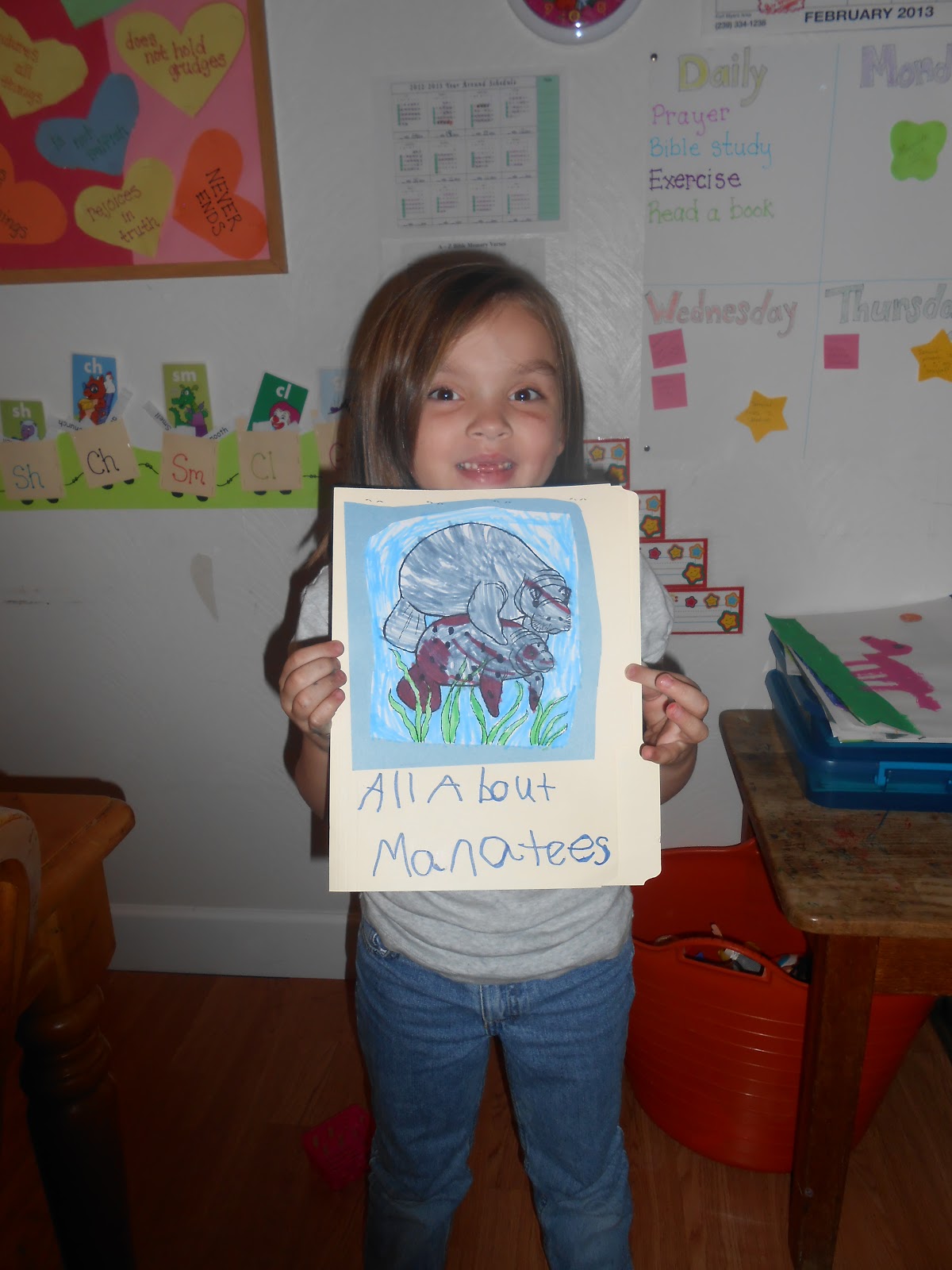
Over the weekend we took a family trip to a nearby Manatee Park ($5 per car for the entire day). I gave Savanna a very simple assignment: learn 3 facts about manatees. Very simple. Other than that, she was to enjoy spending time with family and friends as we watched the manatees in their natural condition, poking their noses in and out of the water for air. Watching as the mommy manatees swam so closely to their little ones; it was truly an incredible sight to see! Not only did we see a lot of manatees, but we also saw plenty of plant life, fish, butterflies, and more. The next day, we used the 3 facts Savanna learned about Manatees to make an "All About Manatees" lapbook.


If I've said it once, I'll say it a hundred times... NEVER UNDERESTIMATE LAPBOOKS! Lapbooks are so much fun and they're jam-packed with information! They're great for kids from preschool to high school and every grade in between. You can make them as simple or as in-depth as you'd like and they're relatively cost-efficient. They can be used for any subject AND even the least crafty kids can complete them! For the manatee lapbook, I had Savanna write a mini-report. We're working on reading and writing, so incorporating that into every lesson is important for us. Her report said, "Manatees are mammals. They have live babies that drink milk, they breathe air, and they have warm blood. Manatees need warm water above 68*. Boats are a danger to manatees." See, simple. We attached her report to the lapbook, along with her Manatee Park bingo card and a picture she drew of a manatee that said, "Manatees began the legend of mermaids." On the back of the lapbook we printed a picture of her standing near the manatee skeleton. It was easy-peasy, fun, and she learned so much!

There are so many great places to visit, just like Manatee Park, where you can take your children to learn "au naturel." Most State Parks only charge for parking, and you can bring a picnic lunch. You can even check out what's going on in your own backyard. You can make lapbooks, go on a Nature Scavenger Hunt, play Nature BINGO, and more! Whatever you do, get out and learn "au naturel!" What a great way to spend the school day!

Bye for now,
Kristina


Friday, January 18, 2013

Homeschooling: The Early Years (2-5yrs)


There are many reasons you may choose to homeschool your children:

  • A desire to take responsibility for your child's education
  • A desire to provide a more well-rounded and Christ-centered education
  • Dissatisfaction with the public school system and teacher/pupil ratio
  • Adverse peer pressures and unsafe school environments
  • A desire to give your child opportunity for individual instruction
  • Medical/health concerns of your child
  • High cost of private tuition
  • Religious reasons- public education conflicting with Biblical values, ie. evolution, abortion, homosexuality, premarital sex, etc.
Whatever your reason for choosing to homeschool, it's a HUGE decision and it will not be easy! And if you're anything like me, you were probably overwhelmed by the whole concept thinking, "Where do I start!?!"

I started teaching both my oldest children at the age of two and I was completely confident in their education until my daughter reached Kindergarten; suddenly I was filled with the fear that I have no idea what I'm doing! What if I haven't taught her enough? What if she doesn't know what other Kindergartners know? How do they keep track of her grades and how does she pass on to 1st grade? What curriculum should I use? There are so many questions and it's a little daunting. But a sweet friend of mine who has been homeschooling for a long time gave me some great advice that I'm going to share with you...

LET THEM PLAY!

That's right folks. Play. Kids in the early years, ages 2yrs - 5yrs are very special. They're like little sponges and they can absorb so much information. They learn so quickly and they learn hands-on. They are curious about everything and the best way for them to learn is through everyday life. It's unnatural for a child at this age to sit at a desk and do bookwork for long periods of time. Their little brains aren't made that way. They want adventure, they want messes, they want to ask questions, they want to see how things work. Kids in the early years benefit greatly from learning through life experiences. So stop freaking out and take a deep breath. Your child is learning all the time and the fact that you want to homeschool shows that you are already invested in their education. You have been teaching your child since day one and he is most likely well above the curve already!

Go out in the yard and talk about how plants grow, different types of weather, season changes, how caterpillars change into butterflies, collect and compare flowers, leaves, rocks, and nuts... there are so many wonderful things to learn in nature. Have your child help you bake cookies or cook a meal and talk about following instructions carefully, using proper measurements, how different ingredients combine to make something new... and enjoy spending that special time together. Create things with play dough, put puzzles together, play hopscotch, go on scavenger hunts, draw pictures, read books as often as you can, paint, sing, dance... PLAY!

Aside from that, there's a couple staple resources that I think you should have for teaching kids in the early years. I would recommend the following:

1) A Good set of flashcards for the alphabet, colors, numbers 1-20, and shapes. You can buy them premade or you can make them yourself. I have a small laminating machine and I make my own so I can personalize them for my children. For example, my son loves Marvel superheroes so I made shapes with his favorite characters. Great motivator to learn the shape (s! Use the flashcards to play games like memory, go-fish, matching, etc.

2) Writing tablets to practice handwriting. You can buy a tablet from the Dollar Tree for $1 or you can print them off Starfall's teacher's lounge for free (other than ink and paper). A fun way to practice handwriting is to have your child get a pen-pal. Savanna has four actually and she LOVES writing them letters and receiving responses!

3) Phonics worksheets and books (for 5yr olds) to begin learning the basics of reading. You can download many of my phonics worksheets and projects here: Fun with PhonicsShort Vowels, Blends, Short & Long Vowels and other things, OO Vowel Diagraph, Phonics Booklets and Another Booklet. You can also purchase pre-reader and level 1 "I Can Read" books to read with your child. Also, Lantern Fish is an excellent resource for reading and phonics activities.

4) Computer games are a great learning resource for young children! I highly recommend Starfall for only $35/year. Your child has access to some really great games that teach letters and letter sounds, phonics, numbers, addition, subtraction, multiplication, division, fraction, problem solving, and more. It's a wonderful website that is EASY for kids to navigate; even the most novice student will enjoy this website. My kids have been using this site since they were 2yrs old and they love it. It also has a "Teacher's Lounge" where you can create printable worksheets for your child. They are pre-made and customizable to suit your child's needs. Very good resource!

5) Math, spelling, and phonics workbooks from the Dollar Tree or Target dollar bin are really great resources for Kindergartners and some preschoolers (when attempting to teach them to sit quietly at a table!).

So in the end, just remember that GOD has begun a good work in you as a parent. You are taking on a huge responsibility to educate your child and God will be faithful to complete that good work through you. Don't let fear and anxiety overwhelm you or distract you from your calling. We all do it, and we all need encouragement to remember that this is an amazing privilege. YES it's the hardest thing I've ever done. It takes every second of every day to be a stay-at-home-homeschooling mommy. There are no breaks and there is no pay. But it's also the most blessed experience of my life and I wouldn't trade it for the world.

So enjoy your kiddos and relax.

Bye for now,
Kristina